
Places > Florence
Uffizi Gallery
Florence, piazzale degli Uffizi
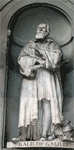
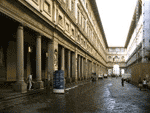
Founded
in 1560, the Uffizi was built at the initiative of Cosimo I de' Medici, to the
project of Giorgio Vasari, as the seat of the most important municipal offices.
In 1565 the construction of the "Corridor" joining the Uffizi to Palazzo
Vecchio and Palazzo Pitti was begun. After the death of both the Grand Duke and
his architect in 1574, the work was continued by Bernardo Buontalenti and
completed in 1580.
Already
in 1581 it is documented that Grand Duke Francesco I was setting up on the top
floor a gallery in which to conserve and display his own collections. This is
the birth certificate of one of the world's most important museums, a great
collection of art and science. The heart
of the Gallery is the Tribune of Buontalenti: with a hexagonal ground plan inspired by the Tower of the
Winds in Athens, it is imbued with symbolic allusions to cosmic order.
Next
to the Tribune, in a small room known as the Stanzino delle Matematiche,
scientific instruments and papers were kept. This was a little "room dedicated
to the study of military architecture", in which to display machines for
lifting weights, mathematical instruments (some of then now in the Museum of
the History of Science) and "books and papers on geography and plans and models
of fortresses." The first decorations in the Stanzino delle Matematiche were
completed in 1599-1600 by Giulio Parigi, who created there, alongside the celebration
of Medicean exploits and Florentine professional traditions, a visual history
of mathematics. The portraits of Pithagoras, Ptolemy and Euclid are associated
with the mathematical basis of the military art. But the unrivaled hero of this
visual history is Archimedes, whose apotheosis in the Stanzino bears witness to
the revival of interest in the scientist from Syracuse occurring during those
years, as exemplified by the arrival in Florence of the codex of his works in
Greek, now in the Biblioteca Mediceo-Laurenziana. Sixty years later Grand Duke
Ferdinand II and Prince Leopold de' Medici dedicated new attention to
mathematics in the West Corridor of the Gallery. Here Galileo Galilei was
honored as the "New Archimedes". In 1780 Filippo Lucci added to the iconography
of the Stanzino a series of images depicting electrostatic devices, an obvious
sign of the interest that such apparatus was attracting near the end of the
18th century. In the Uffizi Gallery today, the Stanzino delle Matematiche is
"Room 17, of the Hermaphrodite". At the center, in fact, is the Sleeping Hermaphrodite, the Roman copy
of an original bronze by Polycletus.
Between
1587 and 1591 the corridors of the Uffizi were adorned with the series of
paintings portraying illustrious men, the series called "Jovian" because it was
inspired by the model of the museum belonging to the erudite Paolo Giovio. This
was the first and most important nucleus of the rich iconographic collection
destined to encounter even greater splendor over the centuries. Among the
personages portrayed are many scientists: Giovanni Alfonso Borelli, Robert Boyle,
Tycho Brahe, Cartesio, Antonio Cocchi, Galileo Galilei, Guido Grandi, Giovanni
Kepler, Alessandro Marchetti, Pietro Andrea Mattioli, Girolamo Mercuriale,
Isaac Newton, John Ray, Francesco Redi, Niccolò Stenone, Evangelista
Torricelli, and Vincenzo Viviani.
If
today the core of the collections consists basically of the paintings and the
sculpture gallery, in the first conception of the museum the art collections
coexisted with the naturalist ones, with the scientific instruments and the
armory. A substantial renewal of the Gallery was undertaken by Pietro Leopoldo,
who transferred the scientific collections to the Museum of Physics and Natural
History. Today the minerals, stuffed animals, fossils, measurement instruments
and objects of scientific interest in general are kept mainly in the various
sections of the Museum of Natural History of the University of Florence and the
Institute and Museum of the History of Science.